Origins in the Charter Town
The regular market square as a fixed urban element in Poland emerged with the wave of town foundations under Magdeburg Law from the thirteenth century onward. When a new town was established under this legal framework, its spatial layout followed a standardised template: a rectangular central square, a grid of streets leading outward from its corners and midpoints, and a church positioned at some distance from the commercial core.
The rynek was not simply an open space — it was a defined legal zone where trade was permitted, regulated, and taxed. Its dimensions were set in proportion to the expected volume of commerce, and the allocation of frontage around its perimeter was controlled by the municipality. Corner plots and those closest to the town hall commanded the highest values and were typically occupied by the wealthiest burghers or guild representatives.

The Square as Administrative Centre
Through the medieval and early modern periods, the rynek served simultaneously as a trading floor, a judicial site, and a ceremonial space. The town hall occupied the centre of the square in many cases, physically dividing it into sectors used for different categories of trade: grain, fish, textiles, and livestock were often separated by tradition or ordinance.
Public punishments, executions, and proclamations took place in the square, reinforcing its role as the primary space of civic authority. Market days — typically one or two per week in small towns, more frequent in major trading centres — attracted merchants from surrounding villages and, in larger cities, from considerable distances. Kraków's Rynek Główny, the largest medieval market square in Poland at approximately 200 by 200 metres, was an international trading node connecting routes from Silesia, Hungary, the Baltic, and the eastern steppe.
Poznań: A Square That Survived Its Own Rebuilding
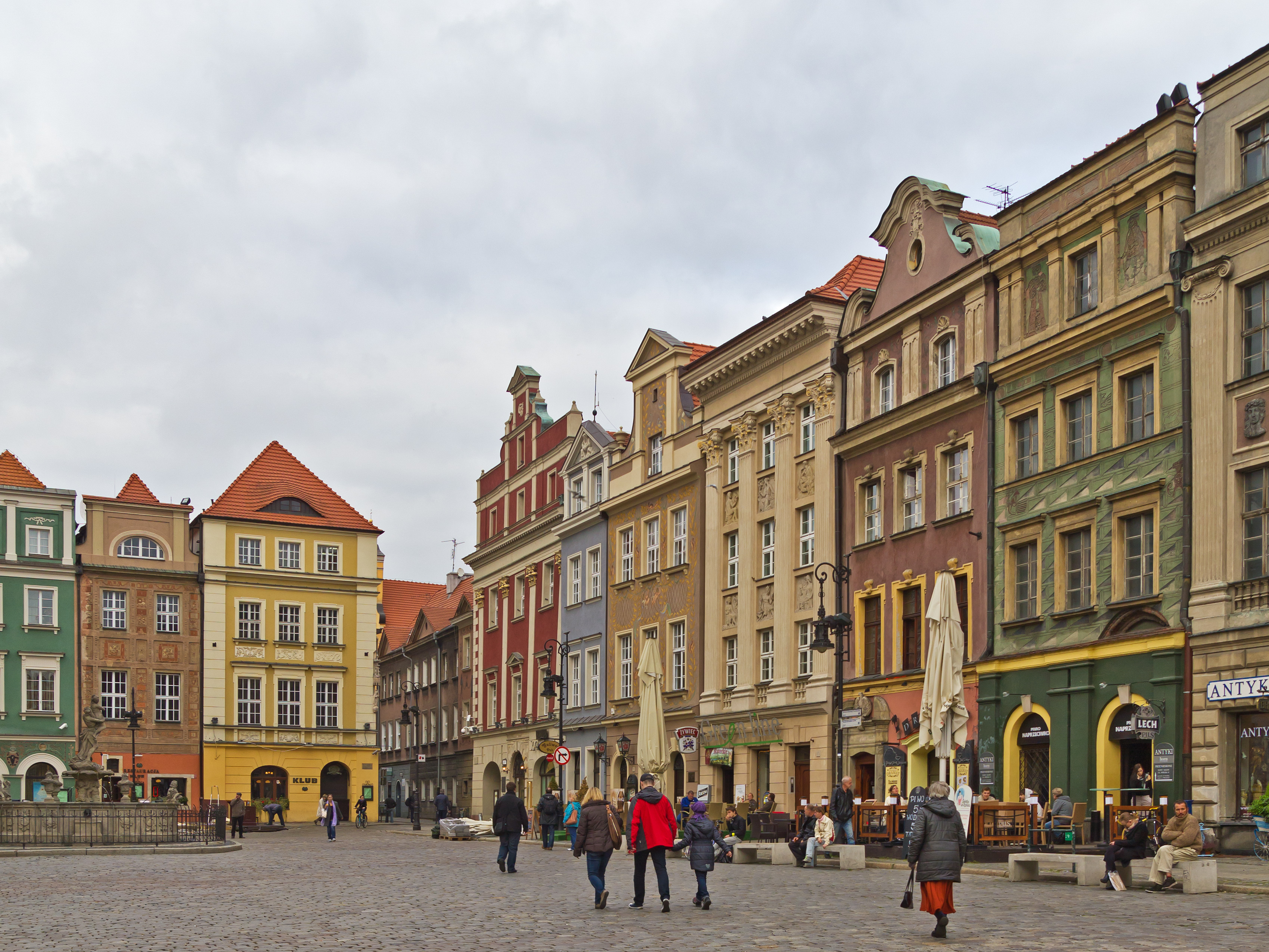
The Stary Rynek in Poznań provides a detailed case for tracing how a single square changed across periods. The thirteenth-century layout established a roughly square outline, approximately 140 by 140 metres, with a town hall positioned at the centre. Over the following centuries, the open space around the town hall was progressively occupied by smaller structures — weighing houses, permanent market stalls, and municipal stores — reducing the available open area considerably.
The Renaissance rebuilding of the town hall by Giovanni Battista di Quadro between 1550 and 1560 introduced a three-storey arcaded loggia that provided covered ground-floor space for commercial activity. This model — a covered arcade at the base of a public building — became a reference point for later market square interventions elsewhere in the country.
The Nineteenth Century: New Functions, New Forms
Industrialisation and urban growth in the nineteenth century placed new pressures on the traditional rynek. Markets that had operated in the open square were increasingly moved to purpose-built covered halls, freeing the central space for pedestrian movement and ceremonial use. Town halls were cleared of surrounding structures, and the square was reformatted as a representational space rather than an active trading floor.
In cities under Prussian administration — Poznań, Wrocław, Gdańsk — this process was accelerated and shaped by German urban planning practice, which emphasised regular facades, monumental public buildings, and the separation of functions. The resulting squares combined historic Polish urban fabric with imported planning principles, producing a layered visual character that remains distinctive today.
Wartime Destruction and Post-War Reconstruction
The Second World War caused severe damage to Polish urban centres. Warsaw's Old Town was systematically destroyed by German forces in 1944 following the Warsaw Uprising; Poznań's old town sustained heavy damage during the Soviet advance in early 1945; Gdańsk lost a large proportion of its historic fabric in March 1945.
Post-war decisions about reconstruction were politically and architecturally contested. In Warsaw, a decision was made in the late 1940s to rebuild the Old Town quarter — including its market square — to its seventeenth-century appearance, using archival records, paintings by Bernardo Bellotto, and surviving fragments as references. The completed reconstruction was accepted to the UNESCO World Heritage List in 1980 as an example of successful historic urban restoration.
The Warsaw Old Town reconstruction represented a deliberate assertion that destroyed urban heritage could be physically reconstituted — a position that influenced heritage practice internationally, though it also drew substantial architectural criticism.
The Contemporary Square
Polish market squares today serve primarily as pedestrian public spaces. Regular markets continue in some locations — Kraków's Rynek hosts a flower market — but the commercial function that originally defined the space has moved largely to permanent retail premises around the perimeter or to separate market facilities. The squares function instead as venues for seasonal events, tourism, and everyday movement through the city centre.
References
- UNESCO World Heritage List — Historic Centre of Warsaw
- UNESCO World Heritage List — Historic Centre of Kraków
- National Heritage Board of Poland — nid.pl